Orthodontic treatment is one of the most sought-after dental procedures among both adults and children. Today, the range of teeth straightening options available is broader, more effective, and more discreet.
Whether you’re considering braces for yourself or your child, this guide offers clear, honest, evidence-based answers. We’ll cover every major teeth straightening option, including what each involves, who it suits, how long treatment typically takes, and what you can expect to pay in Australia.
Before diving in, one important note: the best teeth straightening treatment for you depends on your specific clinical presentation, not on which option looks most appealing online. A consultation with a specialist orthodontist is always the most reliable starting point.
Why Teeth Straightening Matters Beyond Aesthetics
Most people who seek orthodontic treatment are motivated by the desire for a straighter, more confident smile. But the clinical case for teeth straightening goes well beyond appearance.
Misaligned teeth, or malocclusion, are among the most prevalent dental conditions worldwide. Research published in the American Journal of Orthodontics and Dentofacial Orthopedics has consistently found that individuals with malocclusion report worse oral health-related quality of life than those without [1], with severe cases associated with functional limitations, physical discomfort, and reduced social confidence [2].
From a health perspective, crooked or crowded teeth are more difficult to clean effectively, increasing the risk of plaque accumulation, cavities, and gum disease.
Bite misalignment places uneven stress on the teeth, jaw joints, and muscles — contributing to accelerated enamel wear and, in some cases, temporomandibular joint (TMJ) discomfort. Correcting alignment addresses these issues at their root.
Your Teeth Straightening Options in Sydney

There are four main categories of orthodontic teeth straightening treatment available through a specialist orthodontist in Australia. Each has a distinct mechanism, aesthetic profile, cost range, and suitability criteria.
| Feature | Metal Braces | Ceramic Braces | Lingual Braces | Invisalign™ Aligners |
|---|---|---|---|---|
| Visibility | Highly visible (metal) | Low — tooth-coloured | None — behind teeth | Near-invisible — clear tray |
| Removable? | No | No | No | Yes |
| Best for | Complex cases; all ages | Mild–moderate; teens & adults | All complexities; image-conscious adults | Mild–moderate; lifestyle-focused adults & teens |
| Treatment time | 12–36 months | 12–24 months | 18–36 months | 6–24 months |
| Cost (AUD, approx.) | $8,500+ | $9,000–$11,000 | $11,000–$15,000 | $9,000–$12,000 |
| Dietary restrictions | Yes | Yes | Yes | None (remove to eat) |
| Cleaning | Requires extra care | Requires extra care | Requires extra care | Remove and clean normally |
| Staining risk | Minimal | Elastic ties can stain | Minimal | Trays may discolour if not cleaned |
| Sports / mouthguard | Custom mouthguard recommended | Custom mouthguard recommended | Custom mouthguard recommended | Remove aligners for contact sport |
| Suitable age range | Children, teens, adults | Teens, adults | Older teens, adults | Teens, adults |
1. Traditional Metal Braces
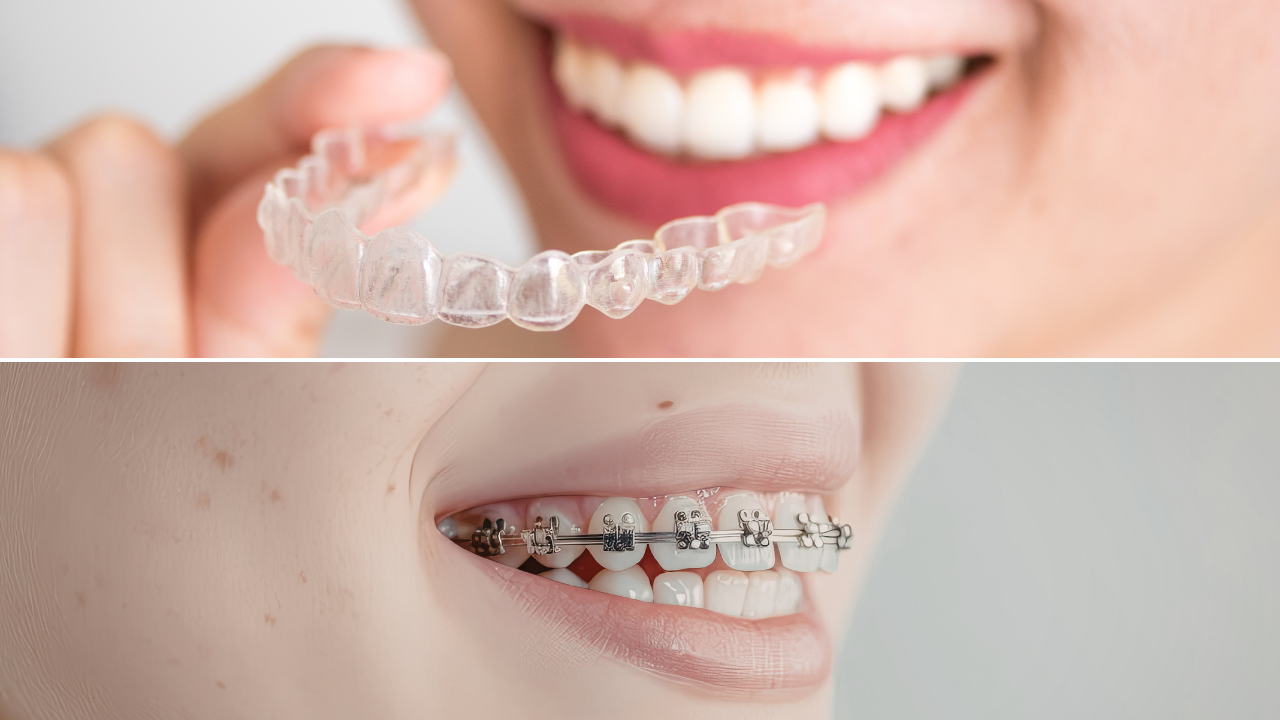
Traditional metal braces are fixed orthodontic appliances consisting of stainless steel brackets bonded to the front surface of each tooth and connected by a thin metal archwire. They work by applying continuous, calibrated pressure to move teeth gradually into their correct positions over the course of treatment.
How They Work
- Brackets are bonded directly to each tooth using a dental adhesive, with an archwire threading through the bracket slots and held in place by small elastics called ligatures.
- Adjustment appointments are every 4–6 weeks; the orthodontist changes or tightens the wire to maintain the force needed to continue tooth movement.
- Over time, the bone surrounding each tooth root remodels in response to this force, allowing the tooth to shift position permanently.
Who they suit: Metal braces are suitable for all age groups — children, teenagers, and adults. They remain the most versatile option for complex cases.
Approximate cost in Sydney: Starts at $8,500 for a standard full-arch treatment, all-inclusive of adjustments and retainers.
Treatment duration: Typically 12–36 months, depending on case complexity.
Considerations
- Highly visible during treatment
- Dietary restrictions apply (avoid hard, sticky foods)
- Requires thorough oral hygiene maintenance around brackets and wires
- Most cost-effective option for complex cases
Learn more about traditional braces at Orthoworx.
2. Ceramic Braces
Ceramic braces, also known as clear or transparent braces, work exactly the same way as traditional metal braces. Brackets are bonded to the front of each tooth and connected by an archwire, with adjustment appointments every 4–6 weeks.
The difference is that ceramic braces use tooth-coloured or clear porcelain brackets instead of metal ones. The result is a far less conspicuous appliance that blends with the natural shade of the teeth and is less visible from a conversational distance.
Who they suit: Particularly popular with older teenagers and adults who want the clinical precision of fixed braces but with a more discreet appearance. Suitable for mild-to-moderately complex cases.
Approximate cost in Sydney: $9,000–$11,000
Treatment duration: 12–24 months for most cases, comparable to metal braces.
Considerations
- Much less visible than metal braces
- Ceramic brackets are more brittle than metal — require some care to avoid breakage
- Elastic ties may stain without careful maintenance
- Slightly higher cost than metal braces due to materials
Learn more about ceramic braces at Orthoworx.
3. Lingual Braces
Lingual braces are fixed orthodontic appliances bonded to the inner, tongue-facing surfaces of the teeth. They are completely invisible from the outside. Every bracket is custom-fabricated to fit the unique contour of each individual tooth, making lingual braces the most personalised fixed orthodontic appliance available.
How They Work
- Using a 3D intraoral scan of the patient’s teeth, custom brackets and wires are precision-engineered in a laboratory and bonded to the inner (lingual) surfaces.
- The orthodontic forces work exactly as with standard braces, but from the inside of the arch.
Who they suit: Best suited to older teenagers and popular with professionals, performers, and anyone in a client-facing role. They can be used across a wide range of case complexities.
Approximate cost in Sydney: $11,000–$15,000, reflecting the custom laboratory fabrication involved.
Treatment duration: 18–36 months, depending on case complexity.
Considerations
- Completely invisible from the outside
- Custom-made for each patient and may come at a higher fabrication cost
- Speech adjustment required initially
- Requires meticulous oral hygiene on the inner tooth surfaces
Learn more about lingual braces at Orthoworx.
4. Invisalign™ Clear Aligners
Invisalign™ clear aligners are a series of custom-made, removable, clear plastic trays that move teeth gradually through a sequence of precisely planned incremental movements. Each aligner tray is worn for approximately 1–2 weeks before being exchanged for the next in the series. The aligners are virtually invisible, can be removed for eating and cleaning, and produce no dietary restrictions.
How It Works
- Treatment begins with a 3D digital scan of the teeth. At Orthoworx, we use the iTero® Element™ intraoral scanner to generate a digital model of the patient’s current tooth positions.
- Specialist software then plans the sequence of movements required to achieve the target result.
- A full series of aligner trays is manufactured from medical-grade clear plastic.
Patients typically wear aligners for 20 to 22 hours per day, removing them only to eat, drink anything other than water, and clean their teeth.
The iTero scanner Orthoworx uses also powers the Invisalign™ Outcome Simulator — a chairside visualisation tool that generates a prediction of the potential post-treatment smile, so patients can see a simulation of their result before committing to treatment.
Approximate cost in Sydney: $9,000–$12,000, depending on treatment tier (Lite / Moderate / Comprehensive) and the number of aligners required.
Treatment duration: 6 months (simple cases) to 24 months (comprehensive cases). Average is 12–18 months.
Considerations
- Near-invisible during treatment
- Fully removable for eating, drinking, and oral hygiene
- Requires strong compliance — must be worn 20–22 hours per day
- Not suitable for all case types, so a specialist assessment is essential
- Higher cost than metal braces for comparable case complexity
Clinical Effectiveness: What the Research Shows
A 2019 systematic review published in BMC Oral Health (Ke et al.) found that clear aligners achieved outcomes comparable to fixed appliances for mild to moderate crowding, spacing, and certain bite corrections, while patient-reported comfort and aesthetics strongly favoured aligners [3].
More recent research, including a 2023 systematic review in Cureus (Jaber, Hajeer & Sultan), found that in complex cases involving significant rotations, torque control, or extraction mechanics, fixed appliances maintained advantages over clear aligners in terms of precision of tooth movement [4].
The clinical consensus is clear: Invisalign™ is highly effective for mild-to-moderately complex cases and has improved significantly with advances in aligner materials and attachment design. For highly complex cases, fixed braces retain clinical advantages.
Invisalign™ at Orthoworx: Diamond Provider Status
Dr Eugene Chan is a Diamond Invisalign™ Provider. This distinction is awarded to clinicians who treat 150–399 Invisalign™ cases per year. Dr Chan has been the Clinical Consultant to Invisalign™ in the Asia Pacific region since 2006 and was the first clinician in the region to achieve Invisalign™ Platinum Elite status.
Learn more about Invisalign™ at Orthoworx.
Ready to Explore Your Options?
Book a free consultation with Dr Eugene Chan at Chatswood or Zetland.
Can You Straighten Teeth Without Braces?
Yes, Invisalign™ clear aligners allow teeth to be straightened without traditional metal braces. For patients with mild to moderate misalignment, clear aligners can achieve results clinically comparable to fixed braces while being removable and virtually invisible.
Beyond Invisalign™, some patients with very mild alignment issues may be candidates for short-course aligner treatments. However, the scope of what is achievable without fixed braces depends entirely on the individual clinical situation. More complex cases typically require fixed appliances for optimal outcomes.
What About At-Home Aligners?
A number of direct-to-consumer (DTC) teeth-straightening products have entered the Australian market in recent years, advertising teeth alignment without requiring orthodontist visits. These typically involve impression kits mailed to the patient and aligner trays manufactured without a clinical examination or X-rays.
The Australian Society of Orthodontists and the Australian Dental Association have both raised formal concerns about DTC aligner products. Without an in-person clinical assessment and X-rays to evaluate root and bone health, there is no way to confirm that tooth movement is safe, appropriate, or biomechanically sound.
The safest and most effective way to straighten teeth without traditional braces is through professionally supervised Invisalign™ treatment with a specialist orthodontist.
Do Retainers Straighten Teeth?
Retainers are designed to hold the position of teeth after active orthodontic treatment; they do not straighten teeth that have not been previously treated. A teeth retainer (whether removable or bonded) is an essential final phase of orthodontic treatment, preventing the natural tendency of teeth to drift back toward their original positions (known as relapse). If your teeth have shifted slightly after a previous course of treatment and you are within a small window of drift, your orthodontist may assess whether a retainer adjustment is appropriate, but this is distinct from active orthodontic treatment.
Invisalign™ vs Braces: Which Is Right for You?
The honest answer is that it depends on your specific case. Here is a framework for helping you decide.
Choose Metal or Ceramic Braces If:
- Your case is complex (e.g. significant crowding, bite correction, large rotations, or extractions required)
- You or your child is younger (metal braces are suitable from around age 10)
- Cost is the primary consideration (metal braces remain the most affordable fixed option)
- You are concerned about the discipline required to wear removable aligners consistently
- You want the fastest possible result for a complex case
Choose Invisalign™ Clear Aligners If:
- Your case is mild to moderately complex, and aligner treatment is clinically suitable
- Discretion during treatment is important to you
- You want to be able to remove the appliance for eating, cleaning, and special occasions
- You have a specific professional or lifestyle reason for preferring a non-visible appliance
- You are an adult or mature teenager who can commit to 20–22 hours of wear per day
The only way to know for certain which option is clinically appropriate for your case is to have a specialist assessment. Read the full Invisalign™ vs Braces comparison at Orthoworx.
Can Teeth Be Straightened at Any Age?
Yes, orthodontic treatment is not limited to childhood or adolescence. While the Australian Society of Orthodontists recommends a first orthodontic evaluation by age 7 to assess jaw development and identify issues early, active treatment can be undertaken at any age.
In children, the jaw is still growing, which means an orthodontist can guide both jaw development and tooth alignment using appliances that would not be effective in a fully developed adult. This is the basis for early, or interceptive, orthodontic treatment.
In adults, the jaw is fully developed, meaning treatment focuses on tooth movement within existing bone. This is highly effective for a wide range of presentations. Adults may take slightly longer to achieve the same movements as teenagers, but the outcomes are equivalent.
Learn more about adult orthodontic treatment and child orthodontic treatment at Orthoworx.
What Is the Cheapest Way to Straighten Teeth?
Traditional metal braces are generally the most cost-effective orthodontic treatment, starting from around $8,500 in Sydney for a standard case. Ceramic braces cost slightly more. Invisalign™ pricing starts from approximately $9,000 for minor corrections and increases with case complexity.
There are a few ways to reduce out-of-pocket costs:
- Private health insurance with orthodontic extras cover: Some Australian policies contribute a rebate toward orthodontic treatment, subject to a lifetime cap (typically $1,500–$3,000). Check your fund’s policy before your consultation.
- Interest-free payment plans: Orthoworx offers in-house interest-free instalment plans, allowing treatment costs to be spread over the course of treatment without interest charges.
- Pay upfront: Orthoworx offers a discount to patients who pay their treatment fee in full before treatment begins, reducing the overall cost.
Common Questions About Teeth Straightening
How long do braces take to straighten teeth?
The duration depends on the type of braces and the complexity of the case. Traditional metal braces and ceramic braces typically take 12–36 months, and lingual braces may take 18–36 months. Most patients notice initial movement within the first 6–8 weeks of treatment.
Can Invisalign™ straighten very crooked teeth?
Invisalign™ can address moderate levels of crowding, including cases that might appear visually quite crooked. However, the clinical threshold for what Invisalign™ can achieve effectively varies between patients, and provider experience plays a key role. Very severe crowding, complex bite corrections, or cases requiring tooth extractions may be better suited to fixed appliances. A specialist assessment is the only reliable way to determine whether Invisalign™ is clinically appropriate for your specific case.
How to straighten teeth naturally?
There is no evidence-based method for straightening teeth “naturally” without orthodontic appliances. Teeth do not correct their own alignment in response to diet, posture, or exercise. Braces and clear aligners are necessary to achieve the controlled, sustained forces required for bone remodelling and tooth movement. Delaying treatment typically allows misalignment to worsen over time.
Do retainers straighten teeth?
Retainers are designed to maintain tooth position after active orthodontic treatment, not to move teeth that have not previously been treated. If you are looking to straighten your teeth, you will need an active orthodontic appliance.
What is the best teeth straightening treatment?
There is no single “best” treatment. The most appropriate option depends entirely on your clinical presentation, age, lifestyle, and budget. Metal braces offer the most clinical versatility; Invisalign™ offers the most convenience and discretion for suitable cases; ceramic braces offer a middle ground; lingual braces offer complete invisibility. A consultation with a specialist orthodontist is the most reliable way to determine which is best for you.
How much does Invisalign™ cost in Australia?
Invisalign™ costs in Australia typically range from approximately $9,000 for minor correction cases to $12,000 for comprehensive, complex treatments. The cost depends primarily on the number of aligners required and the complexity of the tooth movements planned.
Thinking of Booking a Teeth Straightening Consultation in Sydney?
If you’re based in Sydney and ready to explore your teeth straightening options, the best next step is a consultation with Dr Eugene Chan at Orthoworx.
Dr Chan is a specialist orthodontist with over 25 years of clinical experience, a Diamond Invisalign™ Provider, and the Clinical Consultant to Invisalign™ in the Asia Pacific region. He holds specialist registration with AHPRA in NSW and is a member of the Australian Society of Orthodontists.